Course description

This course is a focused, "zero-to-hero" dive into one of the most powerful optimization patterns in computer science. Instead of relying on slow, nested loops that bog down your code, you will learn to use two (or more) indices to traverse data structures simultaneously, effectively cutting execution time from quadratic to linear.

Why This Course?

Most learners understand the concept of a loop, but struggle to know when and how to move multiple pointers to solve a problem. This course bridges that gap by:

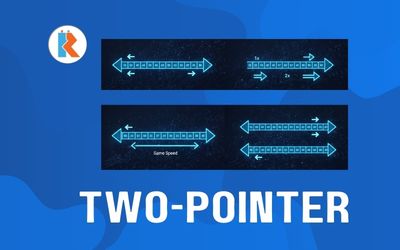
  • Decoding Patterns: Identifying the difference between "Converging," "Fast & Slow," and "Sliding Window" techniques.

  • Visualizing Logic: Moving beyond abstract code to see how pointers "walk" through arrays and linked lists.

  • Interview Readiness: Solving the exact types of problems used by top-tier tech companies like Google, Meta, and Amazon.

The "Hands-On" Edge

This isn't just a lecture. For every pattern, you’ll follow a "Code, Break, Fix" cycle. You will intentionally write the slow version, analyze why it fails on large datasets, and then refactor it into a high-performance two-pointer solution.

By the end, you won't just know the two-pointer approach—you'll have the intuition to spot it in the wild and the precision to implement it bug-free.

What will i learn?

  • You will have a command over using two-pointers in problem Solving
  • Will help immensely in Coding Interviews of Top-IT companies like Google.

Requirements

  • Basic Programming Knowledge (Loops, if-statement, etc.)

Frequently asked question

Not at all. You only need a solid grasp of Arrays (Lists) and basic Loops. While we do cover Linked Lists in the "Fast and Slow" module, the logic remains the same. This course is designed to be the bridge between basic programming and complex algorithm design.

Both can achieve $O(n)$ time complexity, but the Two-Pointer approach is often superior in Space Complexity. Hash Map: - Requires $O(n)$ extra space to store data. Two Pointers: - Usually requires $O(1)$ (constant) space because you are only storing two integer indices.

Yes

This course focus on logic and is not related to any programming language per-se.

Kamal Rawat

Techie, Author, Entrepreneur, Trainer (Founder, CEO @ Ritambhara Technologies)

Kamal Rawat is an accomplished industry leader, author, and entrepreneur. His acclaimed course on Adi Shankaracharya and Vedanta Darshan, conducted under the Kurukshetra Gurukulam Foundation (KGF), has attracted students from around the world. He was the National General Secretary of Ekam Sanatan Bharat Dal, a political movement that contested the 2024 general elections.Kamal had a celebrated career in Software Development with over two decades of experience in building large-scale technology projects across diverse domains. As a technical architect, he has made notable contributions to world-class products, including Microsoft PowerPoint, OneNote, and Adobe Photoshop, demonstrating his depth of expertise and innovation in technologies. As an accomplished author and mentor, Kamal has written several best-seller books on technology and professional growth. He has personally coached more than 5,000 students and professionals in his EdTech . startup Ritambhara Technologies (ritambhara.in), empowering them to excel in their careers and secure positions in top IT companies. His work reflects a rare blend of philosophical . depth, technical expertise, and a passion for transforming lives through knowledge.

₹300

₹500

Lectures

0

Skill level

Intermediate

Expiry period

6 Months

Share this course

Related courses