Rotate image (square matrix) by 90 deg
Tue, 06 May 2025

String matching is a big research area and there are many data structure (eg. B-Tree, HashMap, Set) that help indexing of strings.
There are also many algorithms used for string matching (like KMP, etc.) The major application of Trie data structure is in storing a dictionary (Collection of strings) such the searching for a word in dictionary become O(k) time operation where k is the number of characters in the word.
A HashMap can also do the same, but it can only check if the exact word exists or not. Trie, on the other hand, has many more applications,
Each child is either NULL or a Trie in itself. Each node of a trie also has an indicator to say, weather or not it is the end-of-word. All leaf nodes are end of words, but there can be a non-leaf node at which a word is terminating.
Below picture represent a Trie.
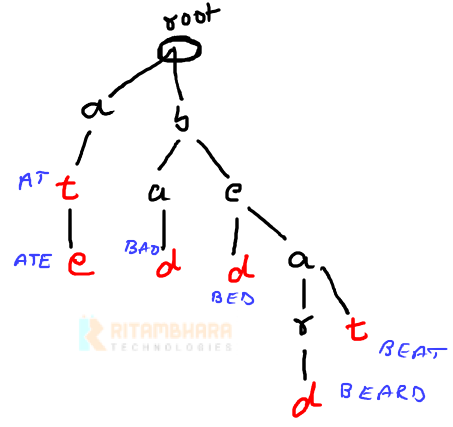
So AT and ATE are both valid words. The structure of Trie node is as below:
#define NO_OF_ALPHABETS 26
struct TrieNode
{
   TrieNode * link[NO_OF_ALPHABETS];
   bool isEndOfWord;
}
isEndOfWord field is true, if the node represent an end of word. Else, it is false. In the picture, this value is true for all the red-nodes.
It is understood that link[i] represent the (i+1)'th character. Potentially, there can be any alphabet that may come after the word. In real implementation, usually we keep a map (Map<Char, TrieNode*>) rather than array to optimise the space. Below are some points about Trie:
Inserting a word in Trie
Inserting is simple, for each character in the trie we follow the path if that character is already present. If that character is not present, then we insert the corresponding nodes, while inserting the last node, we also set the value of isEndOfWord to true.
For example, if we want to insert a new word 'badge' in the previous trie, then path till bad already exist, after that we need to insert two nodes for g and e as shown below.
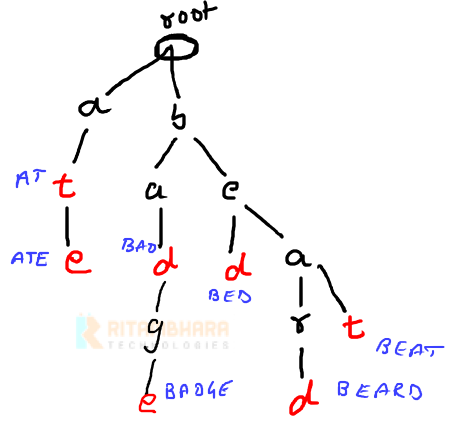
This is a simple recursion, where we move forward if the character is already present, and add node if it is not present till we reach end of the string.
Code
// TrieNode structure
struct TrieNode
{
   TrieNode* child[NO_OF_ALPHABETS];
   bool isEndOfWord;
   // Default constructor, set all the child nodes to NULL
   TrieNode():isEndOfWord(false){
      for(int i=0; i<NO_OF_ALPHABETS; i++)
         child[i] = NULL;
   }
};
// Insert the word in Trie
void insert(TrieNode* root, char* word)
{
   for(int i=0; word[i] != '\0'; i++)
   {
      if(root->child[word[i]-'a'] == NULL)
      {
         root->child[word[i]-'a'] = new TrieNode;
      }
      root = root->child[word[i]-'a'];
   }
   root->isEndOfWord = true;
}
Searching for a word in a Trie
If we want to search whether a word is present in the Trie or not, then we just need to keep tracing the path in Trie corresponding to the characters in word.
// Check if a word is present in the Trie or not
bool isValidWord(TrieNode* r, char* str)
{
   if(str == NULL )
      return true;
   if(*str == '\0')
      return r->isEndOfWord;
   if(r->child[*str - 'a'] == NULL)
      return false;
   else
      return isValidWord( r->child[*str - 'a'], str+1);
}
Tue, 06 May 2025
Tue, 06 May 2025
Tue, 06 May 2025
Prepare to ace your coding and system design interviews with our comprehensive resources and expert guidance! Ritambhara Technologies offers a curated collection of coding challenges, system design tutorials, mock interviews, and behavioral tips to help you stand out. Whether you're targeting FAANG companies, startups, or tech giants, we provide tailored strategies and in-depth solutions to boost your confidence and sharpen your skills. Explore, practice, and succeed!
Leave a comment