Rotate image (square matrix) by 90 deg
Tue, 06 May 2025

 The Video is in Hindi Language
Selection sort is an in-place, comparison sorting algorithm.
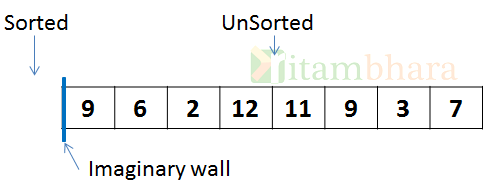
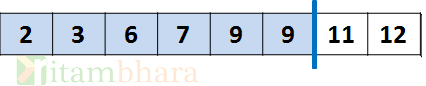
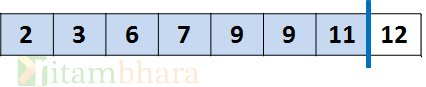
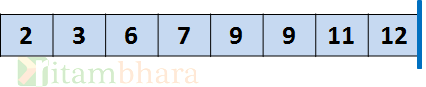
Like bubble sort it also divides the given array in two sub arrays sorted and unsorted, divided by an imaginary wall. Initially all the elements will be in the unsorted list. Each pass will pick the smallest element from the unsorted list and add it at the end of the sorted list, this will move the imaginary wall one step forward making more room in the sorted list and less room in the unsorted list.
After i passes, there will be i elements in the sorted list and (n-i) elements in the unsorted list. Hence we need n passes to sort the entire list, But out of n passes we can skip the last pass, because if n-1 smallest elements are removed from the list, then the last element left will be by default the largest.
Example: Let the initial (unsorted) array be as given below:





void selectionSort(int arr[], int n) {
    for (int i = 0; i < n - 1; i++) {

        // Assume the current position holds
        // the minimum element
        int min_idx = i;

        // Iterate through the unsorted portion
        // to find the actual minimum
        for (int j = i + 1; j < n; j++) {
            if (arr[j] < arr[min_idx]) {

                // Update min_idx if a smaller element is found
                min_idx = j;
            }
        }

        // Move minimum element to its
        // correct position
        int temp = arr[i];
        arr[i] = arr[min_idx];
        arr[min_idx] = temp;
    }
}
Time Complexity: O(n2)
Extra Space used: O(1) - In place algorithm.
Comparison of Selection sort and Bubble sort:
Selection sort is almost similar to Bubble sort. The major difference is that there is only one swap per pass in selection sort where as there is no such limit for bubble sort.
The optimization of bubble sort can also be applied on selection sort. So in a way, it is more optimized than Bubble sort
Tue, 06 May 2025
Tue, 06 May 2025
Tue, 06 May 2025

Prepare to ace your coding and system design interviews with our comprehensive resources and expert guidance! Ritambhara Technologies offers a curated collection of coding challenges, system design tutorials, mock interviews, and behavioral tips to help you stand out. Whether you're targeting FAANG companies, startups, or tech giants, we provide tailored strategies and in-depth solutions to boost your confidence and sharpen your skills. Explore, practice, and succeed!
Leave a comment