Rotate image (square matrix) by 90 deg
Tue, 06 May 2025

Given an array of numbers find the maximum XOR value of two numbers in the array.
Input Array = {12, 15, 5, 1, 7, 9, 8, 6, 10, 13};
Output = 15 (XOR of 5 and 10)
  5 = 0101
 10 = 1010
 ---------
XOR = 1111
Solution-1. Brute ForceThe brute-force solution is to consider all the pairs, compute their XOR and return the maximum of the XOR values.
This is fairly simple and straight forward O(n2) time solution.
void printMaxXOR(unsigned int * arr, int n)
{
   unsigned int maxXor = 0;
   int a = 0, b = 0;
   for(int i=0; i<n; i++)
   {
      for(int j=i+1; j<n; j++)
      {
         if(maxXor < (arr[i]^arr[j]) )
         {
            maxXor = arr[i]^arr[j];
            a = i; b = j;
         }
      }
   }
   cout<<"MAX XOR IS OF " << arr[a] << " and " << arr[b]
       << ". VALUES : " << maxXor;
}
If the function is called like:
int main()
{
   unsigned int arr[] = {12, 15, 5, 7, 1, 9, 8, 6, 10, 13};
   printMaxXOR(arr, 10);
}
Then the output will be
MAX XOR IS OF 5 and 10. VALUES : 15Solution-2: Linear Time Solution
Suppose we have a data structure, that can answer below two queries:
void printMaxXORTrie(unsigned int * arr, int n)
{
   int maxXOR = 0;
   for(int i=0; i<n; i++) {
      //find max XOR of a[i] with num. in collection
      int t = findMaxXOR( ..., a[I] );
      if(t > maxXOR)
         maxXOR = t;
      // INSERT arr[i] in Collection
      insertValueInCollection( arr[i]);
   }
    cout<<"MAX XOR VALUES : "<<maxXOR;
}
The data structure we are choosing is Trie (just Binary Tree) with the following struct of Node
struct Node
{
   Node *left, *right;
   // Constructor. Set left and right to NULL
   Node():left(NULL),right(NULL){}
};
There is no data inside the Node, data is not required. Since we are dealing with Binary values (0 or 1), hence we need only two children for each node (left and right).
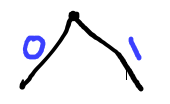
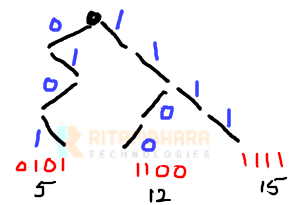
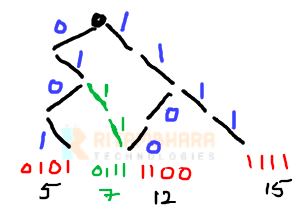
While inserting a number, we look into each bit of that number. If that bit is 1 then we move on right side else, if the bit is 0, we move on the left side.
// Create a trie from the values in the array
void insertValueInTrie(Node* r, unsigned int x)
{
   unsigned int N = sizeof(unsigned int) * 8;
   for(int i=N-1; i>=0; i--)
   {
      unsigned int bitValue = (x & (1<<i)); // Get i'th Bit of x
      if(bitValue != 0)
      {
         if(r->right == NULL)
            r->right = new Node();
         r = r->right;
      }
      else
      {
         if(r->left == NULL)
            r->left = new Node();
         r = r->left;
      }
   }
}
2. How to find the max XOR of a number with numbers stored in Trie
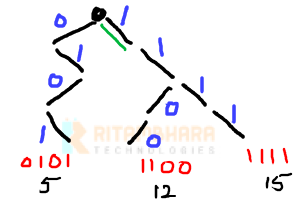
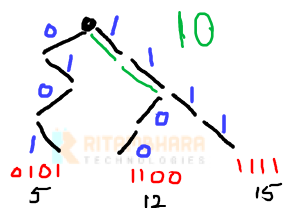
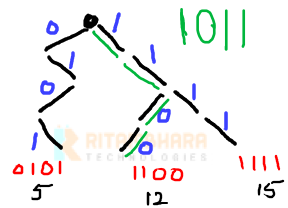
The second point is to find the max XOR value of a given number with all the numbers stored in the Trie. To understand the algorithm, let us revise the flowchart of XORa b a^b -- -- ---- 0 0 0 0 1 1 1 0 1 1 1 0As shown above, the result of XOR is max when the bits are not same. If we want to compute the max XOR of x with numbers stored in Trie, then for each bit of x(starting from MSB), we try to maximise the XOR. If the bit is 1, then we need a 0 to get the max XOR. If the Trie is as shown below:
// Find Max XOR of x in the tree rooted at r.
unsigned int findMaxXOR(Node* r, unsigned int x, int bitPos)
{
   if(r == NULL || bitPos < 0)
      return 0;
   if(bitPos == 0)
   {
      if( (x & (1<<bitPos)) == 1)
         return (r->left == NULL) ? 0 : 1;
      else
         return (r->right == NULL) ? 0 : 1;
   }
   unsigned int bitVal = 0;
   unsigned int number = 0;
   if( (x & (1<<bitPos)) != 0)
   {
      if(r->left == NULL)
      {
         number = findMaxXOR(r->right, x, bitPos-1);
         bitVal = 0;
      }
      else
      {
         number = findMaxXOR(r->left, x, bitPos-1);
         bitVal = 1;
      }
   }
   else
   {
      if(r->right == NULL)
      {
         number = findMaxXOR(r->left, x, bitPos-1);
         bitVal = 0;
      }
      else
      {
         number = findMaxXOR(r->right, x, bitPos-1);
         bitVal = 1;
      }
   }
   if(bitVal == 0)
      number = number & ~(1<<bitPos); // Resetting bitPos
   else
      number = number | (1<<bitPos); // Setting bitPos
   return number;
}
Below is the final code, combining all above functions:
#include <iostream>
using namespace std;
struct Node
{
   Node *left, *right;
   // Constructor. Set left and right to NULL
   Node():left(NULL),right(NULL){}
};
// Create a trie from the values in the array
void insertValueInTrie(Node* r, unsigned int x)
{
   unsigned int N = sizeof(unsigned int) * 8;
   for(int i=N-1; i>=0; i--)
   {
      unsigned int bitValue = (x & (1<<i)); // Get i'th Bit of x
      if(bitValue != 0)
      {
         if(r->right == NULL)
            r->right = new Node();
         r = r->right;
      }
      else
      {
         if(r->left == NULL)
            r->left = new Node();
         r = r->left;
      }
   }
}
// Find Max XOR of x in the tree rooted at r.
unsigned int findMaxXOR(Node* r, unsigned int x, int bitPos)
{
   if(r == NULL || bitPos < 0)
      return 0;
   if(bitPos == 0)
   {
      if( (x & (1<<bitPos)) == 1)
         return (r->left == NULL) ? 0 : 1;
      else
         return (r->right == NULL) ? 0 : 1;
   }
   unsigned int bitVal = 0;
   unsigned int number = 0;
   if( (x & (1<<bitPos)) != 0)
   {
      if(r->left == NULL)
      {
         number = findMaxXOR(r->right, x, bitPos-1);
         bitVal = 0;
      }
      else
      {
         number = findMaxXOR(r->left, x, bitPos-1);
         bitVal = 1;
      }
   }
   else
   {
      if(r->right == NULL)
      {
         number = findMaxXOR(r->left, x, bitPos-1);
         bitVal = 0;
      }
      else
      {
         number = findMaxXOR(r->right, x, bitPos-1);
         bitVal = 1;
      }
   }
   if(bitVal == 0)
      number = number & ~(1<<bitPos); // Resetting bitPos
   else
      number = number | (1<<bitPos); // Setting bitPos
   return number;
}
void printMaxXORTrie(unsigned int * arr, int n)
{
   // ROOT NODE
   Node* r = new Node();
   int maxXOR = 0;
   for(int i=0; i<n; i++)
   {
      unsigned int t = findMaxXOR(r, arr[i], (sizeof(unsigned int)*8)-1 );
      if(t > maxXOR)
         maxXOR = t;
      insertValueInTrie(r, arr[i]);
   }
   cout<<"MAX XOR VALUES : "<<maxXOR<<endl;
}
int main()
{
   unsigned int arr[] = {12, 15, 5, 7, 1, 9, 8, 6, 10, 13};
   printMaxXORTrie(arr, 10);
}
Tue, 06 May 2025
Tue, 06 May 2025
Tue, 06 May 2025

Prepare to ace your coding and system design interviews with our comprehensive resources and expert guidance! Ritambhara Technologies offers a curated collection of coding challenges, system design tutorials, mock interviews, and behavioral tips to help you stand out. Whether you're targeting FAANG companies, startups, or tech giants, we provide tailored strategies and in-depth solutions to boost your confidence and sharpen your skills. Explore, practice, and succeed!
Leave a comment